
Pricing


Employee generated content: The complete B2B strategy guide

April 7, 2026

11
min read

 Open in ChatGPT
 Open in Claude
 Open in Perplexity

Key Takeaways
- Employee-generated content (EGC) is a trust multiplier for B2B brands: employees have a combined reach 10x greater than official company accounts, content shared by people reaches 561% more users than the same message from a brand, and employee posts generate 8x more engagement than corporate accounts.
- EGC acts as distributed SEO: active advocacy programs correlate with 32.4% higher search rankings and 44.9% more inbound traffic, because every employee share sends a micro-signal that shapes how algorithms and AI perceive the brand.
- Real programs deliver measurable results: Fleet Feet saw a 192% boost in organic impressions and 305% more engagement from store-generated content, and a B2B insurance client scaled from 52 to 2,816 employee advocates driving 1.5 million monthly LinkedIn impressions in one year.
- Launching a scalable EGC program takes four steps: pilot with 3-5 internal creators around 2-3 core narratives, remove blank-page friction with prompts and tone variations, use light-touch guidelines instead of strict approvals, and measure pipeline and branded search rather than vanity metrics.
- Compliance guardrails protect the program: employees should disclose their employment relationship (for example #Ad or #CompanyPartner), companies need written consent before repurposing personal posts, and participation must stay strictly voluntary to avoid wage and hour disputes.
- The fastest way to kill an EGC program is the corporate script: identical boilerplate posts get flagged as repetitive by LinkedIn's algorithm, so employees should share their own point of view, and forced brand-page reposts are the lowest value action they can take.
The influence of the corporate image diminished once audiences began to place more trust in a developer's personal 'selfie' than in an expensive, million-dollar brand campaign.
Many marketing teams struggle with the tension between projecting a broad corporate message and allowing employees to shine individually through their expertise. My focus is on selecting the correct strategy to reconcile this.
The next phase of B2B growth will be driven by brands that value genuine communication over rigid corporate messaging. And of course, the highest impact comes from empowering employees to become recognized industry voices.
The search for a dedicated program often starts when manual processes become too difficult to track or scale. This guide breaks down how to build a high-performance engine that aligns company goals with the professional growth of each individual.
What is employee-generated content (EGC)?
My approach is to build a modern brand by focusing on employee generated content, which is defined as any material created by your employee rather than the marketing department.
It shares their unique expertise, daily work life, or professional point of view with an audience. The future of B2B growth is moving away from brand-first creative and toward human-led, personality-driven storytelling.
When the focus shifts to the people behind the company, it creates a more authentic connection with the market.
This is a necessary move for any business looking to build an employer brand while keeping a personal touch.
To understand where EGC fits, I will use a simple framework: UGC for proof, CGC for reach, and EGC for trust.
This strategy works because it hits different triggers for your audience:
- Authenticity: Employees provide a "behind-the-scenes" look that feels more honest than a polished ad.
- Expertise: A developer or salesperson sharing a solution carries more weight than a generic corporate post.
- Relationship: People prefer to follow and engage with other people, which humanizes the entire brand.
Why EGC is your strongest B2B demand generation and SEO lever
Activating a company's collective expertise creates an engine that outperforms even the most expensive paid campaigns. I see the most significant impact when teams adopt an employee-led model; the results fundamentally justify the ROI to stakeholders by changing how the market finds and trusts the brand.
This strategy relies on the fact that individual voices carry a level of authority that a corporate logo simply cannot replicate.
The impact of this shift is measurable across the following critical areas of business growth:
Trust and reach multiplier
The data behind employee networks is clear. Your team members are not just employees; they are a massive, high-trust distribution network:
- Reach: Individual employees typically have a combined reach 10x greater than their company's official accounts.
- More Visibility: Content shared by people reaches 561% more users than the exact same message posted by a brand.
Higher engagement
Audiences are far more likely to interact with a person than a logo. These programs show that content shared by employees generates 8x more engagement than standard corporate brand accounts. This creates the social proof needed to move prospects through the funnel faster.
Distributed SEO
Each time an employee shares content, it sends a "micro-signal" that influences how algorithms and AI perceive and interpret your brand. This acts as a "distributed SEO", which builds your brand's authority across the entire social ecosystem. Instead of relying on a single website, you are creating a web of high-authority mentions.
Traffic and rankings
Investing in a structured advocacy program delivers a direct impact on the bottom line and search visibility:
- 32.4% Higher Search Rankings: Active programs help push your brand higher in search results.
- 44.9% More Inbound Traffic: By diversifying your reach through employees, you drive significantly more qualified leads back to your site.
5 real-world employee-generated content examples
To effectively scale a brand, I implement a structured program designed to empower the team to drive the initiative. These five examples are the gold standard for driving measurable growth through authentic connection.
1. Fleet Feet: The reach multiplier
Fleet Feet is a prime example of how local expertise scales. By empowering individual stores to create their own content, they achieved:
- 38% increase in store-generated content.
- 192% boost in organic impressions.
- 305% jump in overall engagement.
My analysis of these results proves that localized, human-led content consistently outperforms centralized corporate assets.
2. B2B Insurance (SocialPubli): Rapid scale
Scaling an advocacy program requires a framework that removes friction. This B2B insurance client achieved massive growth in just one year:
- Scale: From 52 to 2,816 employee advocates.
- Impact: 1.5 million monthly LinkedIn impressions.
In my experience, using a LinkedIn automation tool is the most effective way to manage this level of growth while keeping the content feeling personal.
3. Salesforce: Authentic recruitment
Salesforce focuses on "day-in-the-life" content to highlight their culture. Instead of polished recruitment ads, they use raw, employee-led stories. The focus here is on transparency—it is the most effective way to attract top talent who value authenticity over a corporate script.
4. Deloitte: Humanizing corporate culture
Deloitte uses TikTok to break the "stiff" corporate stereotype. By allowing employees to share their personalities and office experiences, they humanize a global giant.
My takeaway from this approach is that it turns a massive organization into a relatable brand that people actually want to engage with.
5. Starbucks: The centralized community
Starbucks created the @starbuckspartners platform specifically for its employees. This centralized hub gives partners a dedicated space to share their pride and daily experiences.
How to launch a scalable EGC program in 4 steps
The framework I use for a successful rollout is about strategic enablement. By following these four steps, you can build a self-sustaining content engine that feels human because it actually is.
1. Strategy & goals
Don't try to get the whole company posting at once. I recommend starting by picking 3-5 internal creators to pilot the program. Define 2-3 core narratives, like "Behind the Scenes" or "Expert Tips," to keep the focus sharp without stifling creativity.
2. Enablement & tools
The biggest hurdle for employees is staring at a blank screen. I aim to eliminate that obstacle by offering:
- Prompts and video support: Give them a starting point, not a blank canvas.
- Tone variations: Provide 2-3 versions of company news so they can pick the one that matches their personal voice.
- Smart tech: An automation tool makes it easy for them to schedule and stay consistent.
3. Governance (Trust > Control)
Preaching authenticity while demanding corporate scripts is the fastest way to kill a program. I support the use of flexible, light-touch guidelines instead of strict approval processes. If you trust your employees to represent the brand in a meeting, you should trust them to represent it on a feed.
4. Measurement
Forget vanity metrics like total follower count. My focus is on tracking what actually impacts the business:
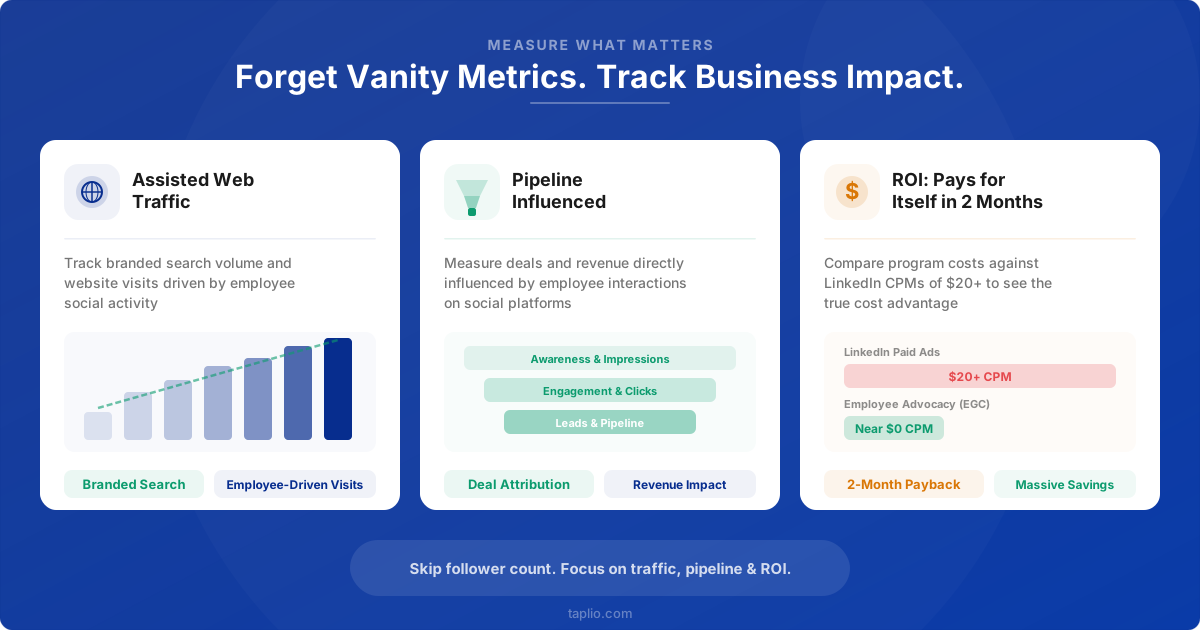
- Assisted web traffic and branded search volume.
- Pipeline influenced by employee interactions.
- ROI: These programs often pay for themselves within two months, especially when compared to $20+ LinkedIn CPMs.
Navigating legal, compliance, and brand safety
My strategy for a sustainable EGC program always prioritizes a "safety-first" framework that protects both the company and the individual. While the goal is authenticity, ignoring the regulatory landscape can turn a successful campaign into a legal headache. I build these guardrails early to ensure that every post strengthens the brand without crossing a line.
FTC disclosure and endorsement
The line between a personal post and an official endorsement is often thin. To keep things transparent, I recommend these essential practices:
- Employment Disclosures: Employees should clearly state their relationship with the company (e.g., using #Ad or #CompanyPartner).
- "Views My Own": While these disclaimers aren't a legal shield, they help distinguish personal opinions from official corporate policy.
- Accuracy: Every claim made by an employee about a product or service must be substantiated and truthful to comply with consumer protection laws.
Content ownership and consent
One of the most common barriers I encounter is the question of who "owns" the content. It is vital to establish clear rules from the start:
- Consent: Always obtain written consent before repurposing an employee's personal post for corporate advertising.
- Usage Rights: Define whether the company has a license to use EGC after an employee leaves the organization.
- Privacy: Ensure that "behind-the-scenes" content doesn't accidentally leak proprietary information or client data.
Voluntary participation
To stay compliant with employment laws, advocacy must be treated as a strictly voluntary activity. Forcing participation can lead to wage and hour disputes, especially with non-exempt staff.
The most effective corporate influencer programs thrive because they offer genuine incentives, like professional brand building, rather than mandatory quotas.
Overcoming the biggest EGC roadblocks
To ensure the program's longevity, my strategy focuses on eliminating the obstacles that typically cause the initial momentum to dissipate after launch. It's one thing to have a pilot group; it's another to keep them engaged without it feeling like a chore. I focus on these two specific hurdles to ensure the program actually scales.
Low participation: The engagement gap
Most programs fail because they feel like "extra work" for the team. I recommend an opt-in model over a mandatory rollout. When participation is a choice, you attract the people who actually want to build their personal brand.
- Non-monetary incentives: Instead of cash, you can offer professional perks. Access to executive mentorship, professional headshot sessions, or early looks at company strategy are far more effective at driving long-term commitment.
- Low-friction tools: A LinkedIn post scheduler allows your team to batch their content in 15 minutes a week, making it a sustainable habit rather than a daily burden.
Overly corporate content: The "Bot" effect
The fastest way to kill employee interest—and algorithm performance—is by forcing everyone to post the same boilerplate copy. Hundreds of programs fail because they treat employees like human billboards.
- Kill the corporate script: If every employee shares the same "We are thrilled to announce..." text, LinkedIn's algorithm will flag it as repetitive and bury it.
- Focus on POV: Encourage your employees to share their unique take on company news. A developer's view on a product update should look completely different from a salesperson's view.
- Avoid "forced reposts": Clicking the "repost" button on a brand page is the lowest value action an employee can take. Try to push for original commentary that adds value to their specific network.
Modern marketing is simple: the most valuable asset you own is the collective expertise of your team. When you stop treating employees like corporate billboards and start empowering them as creators, you unlock a level of trust and reach that no brand account can match. This shift toward human-led storytelling is no longer a "nice-to-have"; it is the only way to stand out in a brand-first world.
Scaling this without burning out your staff requires the right infrastructure to make the process seamless. By giving your team the autonomy to share their unique points of view, you turn a quiet workforce into a high-growth engine.
Ready to turn your team into a growth engine? Launch your EGC program with Taplio today.
FAQ
What is the difference between UGC and EGC?
User-generated content (UGC) comes from your customers and serves as social proof that your product works. Employee-generated content (EGC) comes from your own staff and builds deep authority and trust by showing the expertise behind the brand. While UGC proves the value of the purchase, EGC proves the value of the partnership.
How does employee content impact SEO and AI search?
My strategy treats every employee share as a "distributed SEO" signal. When your team shares expert insights across social platforms, it creates a web of high-authority mentions that helps search engines and AI discovery tools associate your brand with specific topics. This increases your brand's footprint far beyond your main website.
How do you encourage employees to create content without forcing them?
I recommend focusing on the benefit to the employee's personal brand rather than just the company's goals. When you provide professional headshots, access to industry leaders, or early insights into company strategy, employees see content creation as a career-building opportunity. Making it an opt-in process ensures that those who participate are genuinely invested.
Do you have to pay employees for creating content?
In my experience, non-monetary incentives are more effective for long-term commitment. While you should never force participation (to remain compliant with employment laws), rewarding creators with professional development perks or public recognition usually works better than small cash bonuses. It keeps the motivation focused on professional growth rather than a transaction.
What are the best platforms for B2B employee advocacy?
While LinkedIn is the undisputed leader for B2B reach, the "best" platform depends on where your experts live. Go where the conversation is already happening. For developers, that might be GitHub or X (Twitter); for creative or corporate culture, TikTok and Instagram are becoming increasingly powerful levers for humanizing the brand.


Keep reading
All articlesRelated Articles
.avif)
Your Linkedin AI coach is waiting for you
Join 12,000+ creators who let their coach turn the blank page into a plan and watch their audience compound.
7-day free trial · 30 day money back · Cancel anytime
AVG. VIEWS
2,979
-1.5%
ENGAGEMENT
3.2%
+0.8%

Free Monthly Report
How does your LinkedIn compare?
Get free monthly benchmarks on reach, engagement, and content format performance.
Get the Benchmark