
Pricing


How the LinkedIn algorithm works in 2026: complete guide to increase reach

May 21, 2026

11
min read

 Open in ChatGPT
 Open in Claude
 Open in Perplexity
Key Takeaways
- The LinkedIn algorithm in 2026 is a prediction engine, not a checklist: it builds expectations from content format consistency, audience interaction history, and publishing frequency, and suppresses reach when a profile deviates from its established patterns. Average views per post fell 9% globally to a median of 2,704.
- Dwell time only counts after the "see more" click: LinkedIn calculates true reading time once a user expands the post, so a weak hook in the first three lines gets the remaining reading time discounted completely.
- Long posts beat short posts by a full percentage point: updates over 2,000 characters earn a 2.56% engagement rate versus 1.53% for posts under 200 characters, and images lead all formats at 2.77%, ahead of documents and carousels at 2.52% and text-only at 1.98%.
- Small accounts hold the engagement advantage: profiles with 1,000 to 5,000 followers reach the highest median engagement tier at 2.34%, while accounts over 50,000 followers drop to 1.66%.
- Friday 12:00 PM to 1:00 PM UTC is the peak posting window: tracking data from over 200,000 posts shows this hour generates the platform's highest average engagement rate at 2.2%, with the 6:00-7:00 AM UTC commute window close behind at 2.1-2.2%.
- Personal profiles outperform company pages: the prediction engine prioritizes peer-to-peer dialogue, so brands bypass corporate-page suppression with employee advocacy, plus the 4-1-1 content mix (4 industry posts, 1 curated, 1 promotional) and the 95-5 rule, since only 5% of buyers are in-market today.
The LinkedIn algorithm is no longer a code to crack; it is a prediction engine that actively decides who gets attention and who gets silenced. It rewards deep behavioral predictability and triggers immediate systemic skepticism the moment you deviate from your established patterns.
One reliable way to feed the algorithm those early signals is to increase your LinkedIn engagement by commenting on the right posts before and after you publish.
A quick look at our brand analytics report forced me to pause our entire content calendar. The system has shifted fundamentally, meaning our standard playbook was actively triggering algorithmic alarms and killing our reach.
Let's analyze the new rules of the feed and how to fix your reach.
All of the foundational insights and performance numbers highlighted below stem directly from the latest Taplio Benchmark report.
Why your LinkedIn reach is dropping and how the algorithm changed
If your engagement metrics look stagnant, you're not alone. Average views per post fell 9% globally, hitting a median of 2,704 views. The templates and distribution frameworks that carried my content last quarter are actively failing because the platform shifted.
I tracked these exact performance drops against shifting trends using our LinkedIn analytics tool.
The platform no longer runs on a static checklist of rules. Instead, the algorithm functions as a prediction engine powered by continuous behavior loops. It builds a strict expectation of how your account behaves based on three core pillars:
- Content format consistency: The system monitors your structural choices. If you switch from text to unverified formats overnight, it flags the variance.
- Audience interaction history: The engine tracks who regularly reads your text. Erratic shifts in your topics break these established reader loops.
- Publishing frequency: The AI builds a schedule expectation for your profile. Dropping or spiking your volume triggers quality risk filters.
When I suddenly altered our copywriting format last week, it tripped these exact internal alarms. The AI treats erratic profile activity as a quality risk, triggers immediate systemic skepticism, and suppresses your distribution loop.
To recover organic visibility, I had to look over the basic growth hacks and realign my approach using our LinkedIn marketing strategy guide.
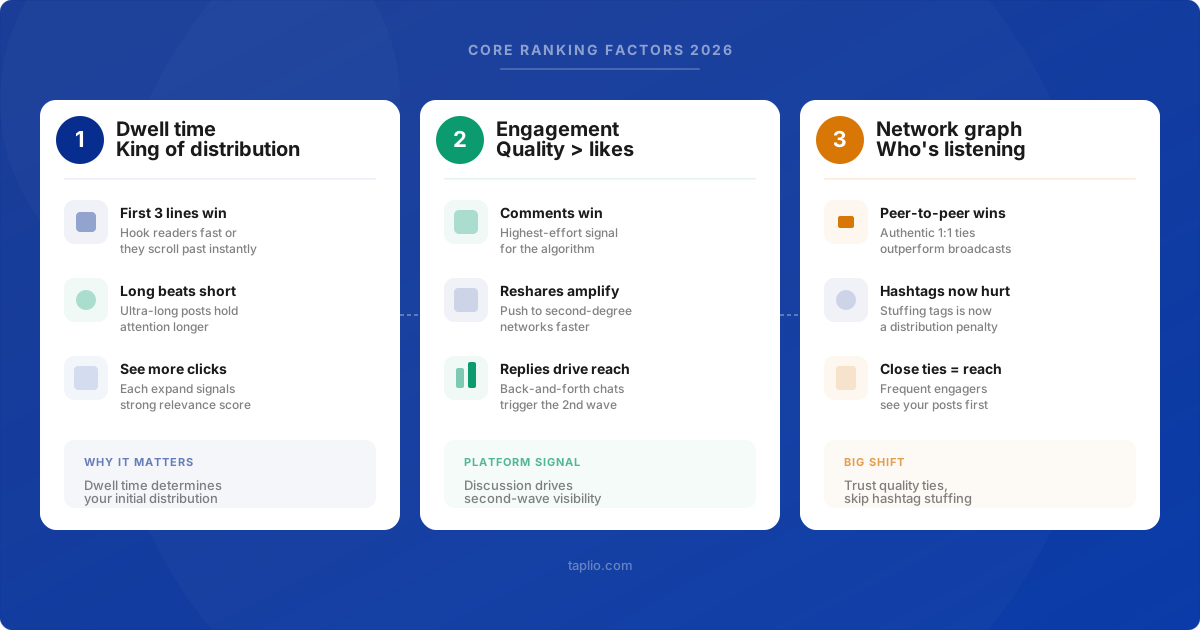
Understanding the core ranking factors today
The modern feed operates on a strict distribution system. The platform uses specific signals to evaluate and distribute text, filtering out low-value content before it reaches your audience.
Many professionals told me that AI text generation tools harm their reach and engagement. The reality is different because template-heavy, repetitive writing causes the drop. The system permits automated text, it simply punishes low-effort output that fails to clear the new technical ranking hurdles.
The real mechanics of dwell time
Forget the old idea that dwell time just means someone pauses on your post while scrolling. The updated system tracks attention with absolute precision.
- The active trigger: The platform calculates true reading time only after a user explicitly clicks the "see more" button.
- The structural hurdle: Boring hooks fail to compel that initial click, leading the system to discount the remaining reading time completely.
- The optimization goal: I structure my introductory lines like a high-stakes narrative to secure that click, ensuring the system registers every subsequent second spent on the text.
You can check our breakdown on the ideal LinkedIn post length to see how formatting impacts this metric.
Engagement quality over total likes
Getting a bunch of basic likes no longer helps push your content to a bigger audience The prediction engine isolates high-value interactions from superficial clicks by analyzing user behavior patterns.
The death of hashtag stuffing
I completely stopped adding blocks of tags to the bottom of my posts this year. The 2026 system relies on advanced semantic scanning and interest graphs to read your actual text for context.
Adding generic tags dilutes your content categorization. The AI scans your sentences naturally, mapping the concepts to specific professional interest clusters and distributing it to relevant feeds without explicit hints. If you want to know how this impacts visibility, read our guide on what are LinkedIn impressions.
Network graph quality
Your total follower count is only a surface level metric. The engine now uses graph neural networks to evaluate the actual relationships between your connections to determine relevance.
The system analyzes who your connections talk to, checking if their industry expertise aligns with your topics. Distribution expands when your content matches the interest profile of your immediate network graph. Irrelevant or inactive connections cause the platform to suppress your reach because the initial relationship signals fail quality checks.
Best performing content formats and lengths for 2026
Choosing your post structure determines whether your text gets distributed or ignored. Hard data reveals exactly what content types and character counts are currently winning in the feed based on recent performance benchmarks. While most marketing blogs tell you to keep it brief, the actual performance metrics prove a completely different reality.
Data shows that ultra-long posts containing over 2000 characters mathematically outperform short posts under 200 characters. Long updates achieve a 2.56% engagement rate, while short updates lag far behind at a 1.53% engagement rate. This means longer posts clear the distribution hurdles by a full percentage point because they provide the prediction engine with enough semantic context to categorize your text accurately.
The current algorithm favors visual asset integration, leaving text-only updates struggling at the bottom of the feed hierarchy. You can maximize your reach by aligning your content schedule with the actual median engagement rates for each major format:
- Images (2.77% engagement): This format remains the top overall winner for driving audience interactions on the platform.
- Documents / Carousels (2.52% engagement): This format is the biggest riser in the algorithm, jumping 0.12 points recently as users spend more time swiping through pages.
- Text-Only Updates (1.98% engagement): This format struggles across the board, requiring deep, long-form copy to generate any significant distribution loops.
I completely shifted my content production toward documents to capture this carousel resurgence. I use automated tools to build these multi-page assets quickly and maintain a consistent visual presence in the feed.
Proven strategies to maximize post visibility
Building consistent visibility requires a strategic shift from chasing viral spikes to understanding audience behavior. You can bypass the need for a massive audience by focusing your content structure around proven distribution frameworks and real audience data.
The micro-influencer advantage
Many professionals think they need hundreds of thousands of followers to gain traction in the feed. The data proves that smaller accounts actually hold a massive advantage in distribution quality.
- The small account edge: Profiles with 1,000 to 5,000 followers hold the highest median engagement tier at 2.34%.
- The enterprise dropoff: Massive accounts with over 50,000 followers struggle to maintain intimacy, achieving only a 1.66% engagement rate.
- The strategic takeaway: I focus heavily on deep connection with a smaller, highly relevant audience graph rather than broad, vanity follower metrics.
The 3-2-1 rule for copywriting
To capture attention and secure the crucial "see more" click, I structure my actual text layout using a strict numbers-based framework. This keeps the copy scannable and highly readable.
- 3 sentences to stop the scroll: Use the first three lines exclusively to build a high-stakes hook, forcing the user to pause and click.
- 2 insights of genuine value: Provide two distinct, highly actionable lessons or data points that the reader can apply immediately.
- 1 clear action: Conclude the post with a single, direct question or prompt to drive deep comment threads.
The 4-1-1 rule for content mix
Maintaining a healthy balance in your feed keeps your audience engaged without burning them out on self-promotion. I split my weekly publishing schedule into six distinct slots to protect my relationship graph.
- 4 pieces of industry content: Share four posts focusing on educational insights, trends, and expert breakdowns within your niche.
- 1 piece from an outside source: Share one post highlighting curated knowledge, a book recommendation, or an interesting case study from a peer.
- 1 promotional piece: Use exactly one post to drive a direct business result, promote a service, or highlight a commercial offer.
The 95-5 rule for long-term branding
Chasing quick sales copies usually backfires because of basic buyer psychology. Market research shows that 95% of your target buyers are not in the market to purchase your services today.
Only 5% of your audience is actively looking to buy right now, meaning transactional posts alienate the vast majority of your readers. I prioritize consistent, value-first visibility over short-term conversion hacks.
By showing up predictably in the feed every single week, your brand stays top-of-mind for the remaining 95% of buyers when they finally transition into the active buying window.
The best times to post for engagement
The precise timing of your content determines how quickly the prediction engine catches your initial engagement signals. Optimal publishing windows vary depending on your specific audience location, but global tracking data from over 200,000 recent posts reveals distinct windows where user activity peaks.
Data from these massive datasets highlights a clear pattern for weekday publishing. I schedule my core updates to go live during two main traffic spikes to enhance initial visibility.
- The morning commute window (6:00 AM - 7:00 AM UTC): Early posts catch professionals as they start their workday, consistently driving engagement rates between 2.1% and 2.2%.
- The midday break window (12:00 PM - 1:00 PM UTC): This slot leverages lunchtime scrolling, matching the same high 2.1% to 2.2% baseline performance.
The absolute peak time to publish content during the week is Friday between 12:00 PM and 1:00 PM UTC. This single hour generates the highest average engagement rate on the platform at 2.2%. A synchronized rollout of your best assets during this Friday window gives the algorithm a concentrated burst of user interactions, pushing your text into weekend feeds.
Personal profiles vs. company pages
I learned an expensive lesson about platform structure when I tried to scale a corporate page last year. The platform enforces a strict division between corporate entities and individual creators, and ignoring this split means your updates die a quiet death.
Corporate pages face steep algorithmic hurdles because the prediction engine prioritizes human authentic connection. People want to interact with real individuals, so the system inherently boosts personal profiles to keep the feed conversational. I notice a massive visibility deficit every single time a brand page publishes the exact same updates that I share from my individual profile.
My team successfully navigated these platform limitations by shifting to a structured employee advocacy model. This approach moves the distribution burden away from a single corporate hub and places it directly into the hands of our staff.
- The human network loop: Team members share specialized industry insights from their individual accounts to build direct trust with their peers.
- The organic multiplier: Personal accounts unlock distribution within separate, highly targeted professional interest circles that our corporate brand page can never access.
- The structural bypass: Employee updates clear the platform's quality checks much faster because the engine registers their profile activity as genuine peer-to-peer dialogue.
The current LinkedIn algorithm requires a complete shift in how creators approach organic reach. The 2026 platform update rewards authentic, long-form stories and deep community conversations, instead of quick growth hacks or generic automation. If you format your text to secure that crucial first click and respect your network graph, you can win back your organic visibility.
My team stays ahead of these rapid algorithm changes by relying on concrete, real-time data. You can eliminate the uncertainty around your performance metrics today.
To analyze your profile, track your true dwell time signals, and build a high-performing content strategy that keeps your brand visible, Try Taplio for free
Frequently asked questions
What is the 4-1-1 rule on LinkedIn?
The 4-1-1 rule is a content mix strategy designed to protect your network graph from engagement fatigue. For every six updates you share, four updates must offer industry insights or educational value, one update should highlight curated knowledge from another creator, and exactly one update should feature a direct promotional pitch.
Does the algorithm favor long or short posts?
The algorithm heavily favors ultra-long updates over short blurbs. Recent performance benchmarks show that posts containing over 2,000 characters mathematically outperform posts under 200 characters by a full percentage point, pulling a 2.56% engagement rate compared to a lower 1.53% rate.
Why is my LinkedIn reach suddenly dropping?
Reach usually drops because of template heavy content patterns or low click-through rates on your first three lines. The platform uses specific signals to evaluate distribution, which means boring hooks fail to compel the initial "see more" click, causing the system to discount your remaining reading time completely.
How do company pages perform compared to personal profiles?
Corporate brand pages face massive distribution limitations because the underlying prediction engine prioritizes authentic peer-to-peer dialogue. Personal profiles inherently achieve much higher visibility, which explains why businesses now rely on employee advocacy programs to bypass the steep algorithmic hurdles placed on company assets.
What is the 95-5 rule on LinkedIn?
The 95-5 rule dictates that 95% of your target business audience is not ready to purchase your products or services today. Only 5% of your market is actively looking to buy right now, meaning consistent visibility beats short-term growth hacks because you stay top-of-mind for the remaining 95% of buyers when they finally enter the market.


Keep reading
All articlesRelated Articles
.avif)
Your Linkedin AI coach is waiting for you
Join 12,000+ creators who let their coach turn the blank page into a plan and watch their audience compound.
7-day free trial · 30 day money back · Cancel anytime
AVG. VIEWS
2,979
-1.5%
ENGAGEMENT
3.2%
+0.8%

Free Monthly Report
How does your LinkedIn compare?
Get free monthly benchmarks on reach, engagement, and content format performance.
Get the Benchmark