
Pricing


LinkedIn Personal Branding: The Strategic Guide to Building Authority (2026)

June 9, 2024

12
min read

 Open in ChatGPT
 Open in Claude
 Open in Perplexity
Key Takeaways
- Only 1% of LinkedIn's 1 billion+ users create content: that gap makes personal branding a massive opportunity, and a personal brand differs from a digital resume by showcasing unique value to a specific audience instead of listing past duties.
- The 5-3-2 rule keeps a LinkedIn feed balanced: for every 10 posts, publish 5 value posts (tips and how-tos), 3 authority posts (case studies and results), and 2 human posts (personal stories).
- A LinkedIn headline should follow the formula "[Role] Helping [Audience] Achieve [Result]": paired with a cover image that states the problem solved, it turns the profile into a high-converting landing page.
- A 17-minute daily routine sustains LinkedIn growth: 5 minutes commenting on Top Voices, 5 minutes replying to every comment on your posts, 5 minutes sending three personalized connection requests, and 2 minutes scanning your target audience's activity.
- External links in the post body kill reach: LinkedIn rewards keeping users on-platform, so links belong in the comments, hashtags should cap at 3 (1 broad, 2 niche), and being first to comment on your own post triggers early engagement signals.
- High-signal metrics beat vanity metrics: inbound DMs, profile views, and quiet decision-maker followers indicate real ROI, and a 90-day plan scales from commenting only (month 1) to 1 post per week (month 2) to 2-3 posts per week (month 3).
I used to treat my LinkedIn profile like a static digital resume. I was posting randomly and hoping for likes that never turned into real business opportunities.
The reality is that your profile is not just a resume; it is your most powerful tool for professional visibility.
In this guide, I will share the exact framework to move from a basic profile to a personal brand that drives inbound DMs and actual revenue.
Why "Posting More" Is Not a Personal Brand Strategy
Many people think that being active on LinkedIn is the same as having a brand. I fell into this trap early on. I was posting daily updates, but my inbox remained empty.
There is a major difference between a digital resume and a personal brand:
- Digital Resume: A static list of your past duties and job titles.
- Personal Brand: A living strategy that showcases your unique value and authority to a specific audience.
LinkedIn now has over 1 billion users. However, only 1% of those users actually create content. This gap is a massive opportunity for you to lead conversations in your industry.
Is LinkedIn actually good for personal branding? The answer is yes. It is the only platform where your professional story, your network, and your content live in one place.
If you want to start building this authority today, I recommend checking out this LinkedIn personal brand crash course to get your foundations right.
Step 1: The Foundation (Strategy Before Tactics)
I learned that jumping straight into posting is a mistake. Without a solid foundation, you are simply wasting your effort. This section is what most of your competitors miss.
Audience Definition
You must decide who you are talking to before you write a single word. I use a simple persona framework to identify their specific needs, pain points, and preferred content formats.
If you try to talk to everyone, you end up reaching no one.
The "Niche of One"
Your Unique Value Proposition (UVP) is what sets you apart in a crowded feed and becoming an expert in one specific niche is much more effective than being a generalist.
- Identify your edge: Find the one problem you solve better than anyone else.
- Research the market: Perform a competitive analysis to see what others are missing.
- Position yourself: Define your niche so clearly that you have no direct competition.
I have spent a lot of time researching what actually works for growth. Experienced users on Reddit consistently share one specific tip: stop trying to be everything to everyone. They suggest that you should become the "go-to" expert in a tiny niche. This is how you build a reputation that sticks.
Building a name is the only asset that stays with you forever, and you can see how to trade your excuses for a working system in this video.
Step 2: Optimizing Your Profile to Convert Traffic
Your profile must act as a high-converting landing page. This top-to-bottom audit ensures every section actively serves your brand.
The Hook: Visual Trust Signals
Your headshot and banner are the first things people see. These are your primary visual trust signals. Your cover image should clearly reflect the specific problem you solve for your clients.
The Pitch: The Headline Formula
Move beyond simple job titles to show real impact. You’ll need a formula that tells the reader exactly what value you provide:
- [Role]
- Helping [Audience]
- Achieve [Result]
Example : “I help Sales Executives reach 90% of closing after each call”.
The Story and Proof
The "About" section is the only part of your profile written fully in your own voice. Use this framework to structure your content and engage the reader:
Your Hook → Your (personal/ professional) Story → Call to Action
Additionally, convert your experience section from a list of daily duties into a list of measurable achievements. You can check out these LinkedIn personal branding examples to see this structure in action.
Profile Tip: Ensure your cover image reflects the problem you solve and integrate relevant keywords from both social and Google searches throughout your profile to increase visibility.
Step 3: Content Strategy (The 5-3-2 Rule & Beyond)
Posting on social media without a structured approach quickly leads to burnout. To maintain a long-term presence and build both value and trust, I utilize a specific content ratio.
The 5-3-2 Rule
This framework ensures you do not sound like a salesperson. For every 10 posts:
- 5 Value Posts: Educational tips and how-to guides.
- 3 Authority Posts: Case studies and results that prove your expertise.
- 2 Human Posts: Personal stories or behind-the-scenes looks.
12 Post Types (Condensed)
I categorize my content into three main pillars to keep my feed diverse:
- Authority Builders: Case studies and step-by-step guides.
- Engagement Drivers: Polls, industry hot takes, and personal narratives.
- Trust Signals: Highlighting social proof and showing your process.
Formatting for Dwell Time
LinkedIn prioritizes how long someone stays on your post. To keep people reading, I focus on mobile optimization:
- The Hook: A scroll-stopping first line.
- White Space: Frequent line breaks for easy scanning.
- No External Links: Put links in the comments to protect your reach
Content Tip: Be honest with yourself, posting once or three times a month will not cut it. Consistent, frequent posting is key on LinkedIn.
You can use a LinkedIn content calendar to organise your content creation.
Step 4: The "17-Minute" Daily Growth Routine
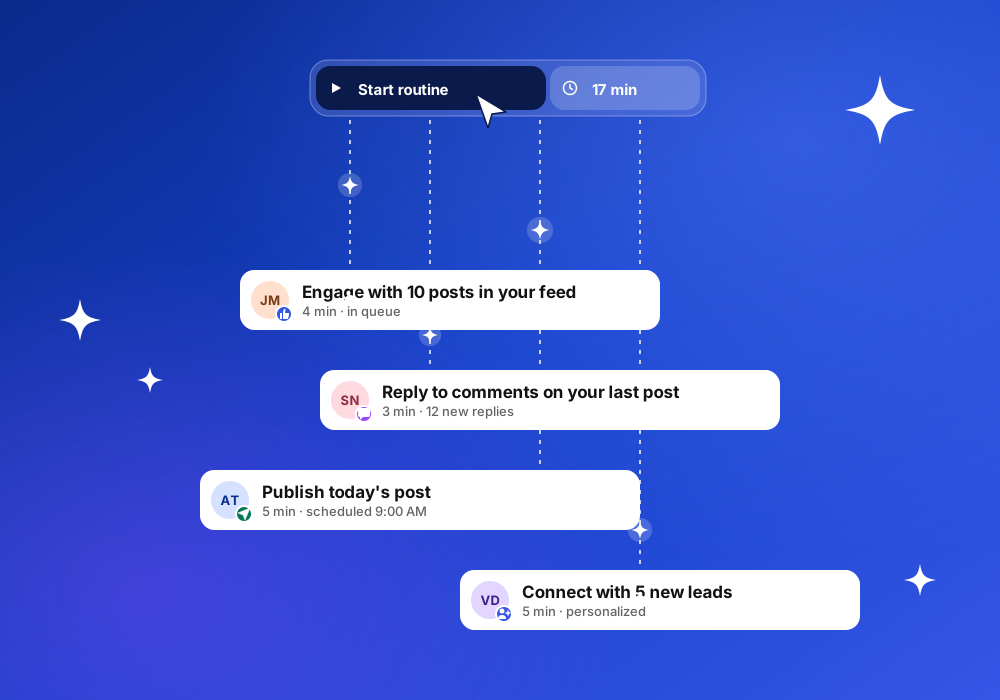
My secret weapon for growth is efficiency, as the biggest obstacle is the misconception that significant time must be spent on the platform. To maintain visibility without it becoming a full-time commitment, I follow a precise 17-minute routine.
The Breakdown
This daily routine ensures you are both seen and heard:
- 5 Minutes: Engage with "Top Voices" in your niche. Leaving insightful comments on their posts puts you in front of their massive audiences.
- 5 Minutes: Reply to every comment on your own posts. This rewards your current audience and signals to the algorithm that your content is worth promoting.
- 5 Minutes: Send three personalized connection requests. I prioritize quality over quantity to build a high-value network.
- 2 Minutes: Quickly scan your target audience’s recent activity to stay informed on their current challenges.
The Power of Commenting
I realized early on that for beginners, commenting is often more potent than posting. It allows you to borrow authority from established creators while you build your own. You can use LinkedIn analytics tools to track which of these interactions are driving the most profile views.
Expert consensus on platforms like Reddit suggests that your growth is tied more to your engagement than your original content.
If you struggle with what to say, I recommend watching this video on how to find inspiration for daily interaction.
6 Battle-Tested Tips from Reddit & Power Users
Strategy and routines are important, but the "hidden" tactics often determine how fast you scale. I’ve sourced these specific, high-impact tips from top-performing Reddit threads and power users to help you gain an edge.
1. Be a "Content Goblin"
Don't be afraid to show your personality. Differentiation is key on a platform that can often feel sterile.
"Be controversial, silly, or straight-talking if you want... If you're mad into D&D, movies, or some other hobby, try using that as an example. Be a content goblin."
2. Create "Engagement Lists"
If your feed is full of noise, take control of your networking. I recommend creating an Excel sheet or a Taplio list of 10-20 high-value profiles in your niche and committing to engaging with 10-15 of them daily.
3. The "No Link" Rule
LinkedIn wants to keep users on its platform. I’ve found that posts with external links in the body get significantly less reach. Always share your links in the comments section to keep the algorithm happy.
4. Self-Commenting
Be the first to comment on your own post. Adding an extra insight or a question as the first comment triggers initial engagement signals and encourages others to join the conversation.
5. Max 3 Hashtags
Spamming hashtags makes your content look like spam. I keep it focused: 1 broad tag (e.g., #Marketing) and 2 niche tags (e.g., #SaaSGrowth).
6. Personal Experience Over General Advice
Authenticity wins every time. Statements like "I did X" consistently perform better than "Here's how to do X." Sharing your actual journey builds more trust than acting like an untouchable authority.
Real-World Examples: Personal Brands That Work
To see these strategies in action, take a look at how different profiles leverage the "Landing Page" approach.
Example A: The Solopreneur (Lead Generation)
Justin Welsh is the gold standard for the "Niche of One." His brand works because of:
- Visuals: A clean, minimalist banner that explicitly states the problem he solves (building a portfolio of one).
- Tone: Highly disciplined and "straight-talking," which builds immediate authority with other entrepreneurs.
- Consistency: He uses a templated style for his daily posts, making his content instantly recognizable in a crowded feed.
Example B: The Executive (Thought Leadership)
Richard Branson uses his profile to humanize a global conglomerate. His brand works because:
- The "Human" Element: He masters the 2 in the 5-3-2 rule by sharing personal adventures and failures.
- Visual Trust: High-quality imagery that bridges the gap between a corporate leader and a relatable mentor.
- Engagement: He focuses on broad industry "hot takes" that spark massive conversation, driving visibility back to Virgin’s core values.
Why They Win
Both creators go beyond a "digital resume." They treat their profiles as a destination where the Hook, Pitch, and Proof are visible within seconds of landing on the page.
The 90-Day Launch Plan (From Zero to Authority)
Building a personal brand is a marathon, not a sprint. To avoid burnout, I recommend this staged roadmap. It moves you from a silent observer to a recognized authority by focusing on one layer of the system at a time.
Month 1: The "Lurker to Leader" Phase
Your goal this month is to build your foundation without the pressure of "going viral."
- Profile Cleanup: Complete your top-to-bottom audit (Hook, Pitch, Story, Proof).
- The Commenting Strategy: Spend your 17-minute routine primarily on other people's posts. Aim for 5–10 high-value comments daily to start appearing in relevant feeds.
Month 2: The "5-3-2" Challenge
Now that your profile is a landing page, start driving your own traffic.
- 1 Post Per Week: Focus on quality over quantity. Use the 5-3-2 Rule to decide your topic.
- Master the Hook: Spend 50% of your writing time on the first sentence. If they don't click "see more," the rest of the post doesn't exist.
Month 3: Scaling & Analysis
This is where you move beyond vanity metrics and start treating your brand like a business.
- Frequency Boost: Aim for 2-3 posts per week.
- Conversion Audit: Check your "Profile Views" and "Custom Button" clicks. If your views are up but your followers aren't, go back to Step 2 and refine your Headline or About section.
The "Anti-Vanity" Mindset: Measuring What Matters
Before you post your first "Value" update, you must undergo a crucial mindset shift: Ego is not ROI. Most creators fall into the "Vanity Trap," where 10,000 likes can result in $0 revenue and zero job offers. If your content is too broad, you attract the wrong crowd, or worse, a crowd that cheers but never buys.
To build a brand that actually scales your career or business, you must track High-Signal Metrics:
- Inbound DMs: This is the ultimate indicator of trust. When a peer or prospect reaches out privately, your content has done its job.
- Profile Views: Think of this as your "Top of Funnel." If views are high but your network isn't growing, your Step 2 optimization needs work.
- The "Quiet" Followers: Remember that CEOs and decision-makers often watch from the sidelines. They rarely like or comment, but they are the ones who eventually send the "Let’s talk" message.
To build a strong LinkedIn brand, stop treating it as a passive resume or broadcast channel. Instead, see it as an active business asset and networking tool. Focus on providing specific value and engaging with intent to attract opportunities, ensuring your name holds weight in your industry.
Manage your content and engagement more efficiently by trying Taplio for free here.
FAQ
What is the 5-3-2 rule on LinkedIn?
The 5-3-2 rule is a content framework designed to keep your feed balanced and human. For every 10 posts: 5 should provide pure value (how-to's, tips), 3 should establish your authority (case studies, results), and 2 should be personal or "human" (behind-the-scenes, stories).
How do I build a personal brand on LinkedIn for free?
Focus on organic networking and high-value content. You don't need paid ads or premium accounts to start. Optimize your profile to act as a landing page, engage meaningfully with "Top Voices" in your niche through comments, and post original insights.
How often should I post on LinkedIn for personal branding?
Consistency beats intensity every time. While posting daily is ideal for rapid growth, it is better to post high-quality content three times a week than to post low-value content daily. Find a rhythm you can sustain for months, not weeks.
Can I build a brand while working a full-time job?
Absolutely. Most successful personal brands start as side projects. To navigate employer concerns, focus on being a "thought leader" rather than a "job seeker." Share industry insights and solve problems publicly. This demonstrates your value to your current employer while simultaneously building your own portable asset.
Is it better to have a Company Page or Personal Profile?
For personal branding, the Personal Profile is superior. LinkedIn's algorithm prioritizes human-to-human connection over corporate broadcast. People follow people, not logos. Use your personal profile to build the relationship and your company page as a secondary repository for official updates.
How do I find my niche?
Look for the "Niche of One", the intersection of what you are exceptionally good at and what the market is willing to pay for. Ask yourself: "What is the one specific problem people always come to me for?" Start there. Your niche isn't a life sentence; it's just your starting point for building authority.


Keep reading
All articlesRelated Articles


.avif)
Your Linkedin AI coach is waiting for you
Join 12,000+ creators who let their coach turn the blank page into a plan and watch their audience compound.
7-day free trial · 30 day money back · Cancel anytime
AVG. VIEWS
2,979
-1.5%
ENGAGEMENT
3.2%
+0.8%

Free Monthly Report
How does your LinkedIn compare?
Get free monthly benchmarks on reach, engagement, and content format performance.
Get the Benchmark